Hoi An
Top Attractions in Hoi An: Where to Go & What to Skip
By Wander in Vietnam editorial team · Hanoi, Vietnam
Hoi An rewards slow wandering more than checklist-ticking. The real attractions are Chùa Cầu (the iconic Japanese Bridge), Bảo tàng Hội An (the city museum on Trần Hưng Đạo), and Precious Heritage Art Gallery Museum for contemporary Vietnamese craft. Skip the overhyped lantern releases on the river—they're crowded and environmentally harmful. Instead, visit Chợ Đêm (night market on Nguyễn Hoàng) for street food under 50,000 VND (≈US$2), browse embroidery at Sô.Va Art Hand Embroidery or ceramics at the Ceramic Museum on Trần Phú, then watch street life from a café. Admission to temples is free; museums charge 80,000–150,000 VND (≈US$3–6). Plan 2–3 full days here; most visitors undersell the craft workshops and historical guild halls. We recommend timing visits early morning or late afternoon to dodge tour-group clusters. ---
Which Old Town temples actually repay a visit?
Chùa Cầu (the Japanese Bridge) remains essential—its 400-year-old structure, red-painted wood, and symbol status mean you will see it. Arrive before 08:00 or after 17:30 to avoid coach tours. Entry is free. The interior is small and often crowded, but the architecture and rooftop views across the river justify the trip. Hội quán Triều Châu (157 Nguyễn Duy Hiệu) is larger and quieter: a 300-year-old Chaozhou clan hall with ornate carvings, ancestor shrines, and genuine worshippers—not a museum. Free entry. Similarly, Hội Quán Phước Kiến and Hội Quán Quảng Triệu on Trần Phú are working guild halls, atmospheric and undervisited. Most guide books miss them. Go to temples during morning prayer hours (05:00–09:00) for authenticity.
🗺️ Plan your route: Vietnam itinerary
What do the museums actually show—and are they worth it?
Bảo tàng Hội An (10B Trần Hưng Đạo) covers local history, trade, architecture, and daily life from the 15th century onward. Admission ≈150,000 VND (≈US$6). The collection is modest compared to Hanoi museums, but it contextualizes what you see in the streets: why wooden shop-houses exist, how Chinese and Japanese merchants shaped the town, why ancestor worship appears everywhere. The Hoi An Museum of Traditional Medicine holds herbal remedies, acupuncture tools, and old prescriptions—niche but worth 90 minutes if you're interested in Asian medical history. Skip it if museums exhaust you; spend that time in the craft workshops instead. Precious Heritage Art Gallery Museum (26 Phan Bội Châu) bridges old and new: it shows contemporary Vietnamese lacquer, painting, and sculpture in a restored colonial building. ≈100,000 VND (≈US$4). This one is underrated and often quiet—better for art lovers than history buffs.
| Museum | What you learn | Cost (VND) | Best for | Skip if |
|---|---|---|---|---|
| Bảo tàng Hội An | City history, trade, 15th–present | 150,000 | Context-seekers | In a rush, prefer hands-on |
| Hoi An Museum of Traditional Medicine | Herbal medicine, acupuncture history | 90,000–100,000 | Wellness/history nuts | Not into medicine |
| Precious Heritage Art Gallery | Modern Vietnamese art & craft | 100,000 | Art collectors, photographers | Museum fatigue, time-pressed |
Which craft workshops and galleries earn your money?
Sô.Va Art Hand Embroidery (111 Trần Phú) is a working studio, not a shop. You watch artisans embroider silk pieces—bags, wall hangings, scarves—by hand; some take months. Prices start around 500,000 VND (≈US$20) for small items, up to millions for large panels. The craft justifies the cost. Boa tang gom su mau dich (80 Trần Phú) displays ceramics—earthenware, stoneware, glazed vessels—made by local potters. No factory mass-production here; pieces are individual. Prices from 100,000 VND (≈US$4) for small bowls to 5,000,000+ VND (≈US$200) for large sculptural works. You can watch artisans work and commission custom pieces. Both are genuine, zero-pressure, and more memorable than souvenir stalls. Casa Tan my (101 Nguyễn Thái Học) and Diep Dong Nguyen (58 Nguyễn Thái Học) are lacquer workshops where you can observe the multi-layer process: each piece takes weeks. Lacquerware ranges from 200,000 VND (≈US$8) to several million, depending on complexity and artist reputation.
📸 Book an ao dai photoshoot in Hanoi or Saigon (Cáo Studio)
Should you visit the night market and fabric quarter?
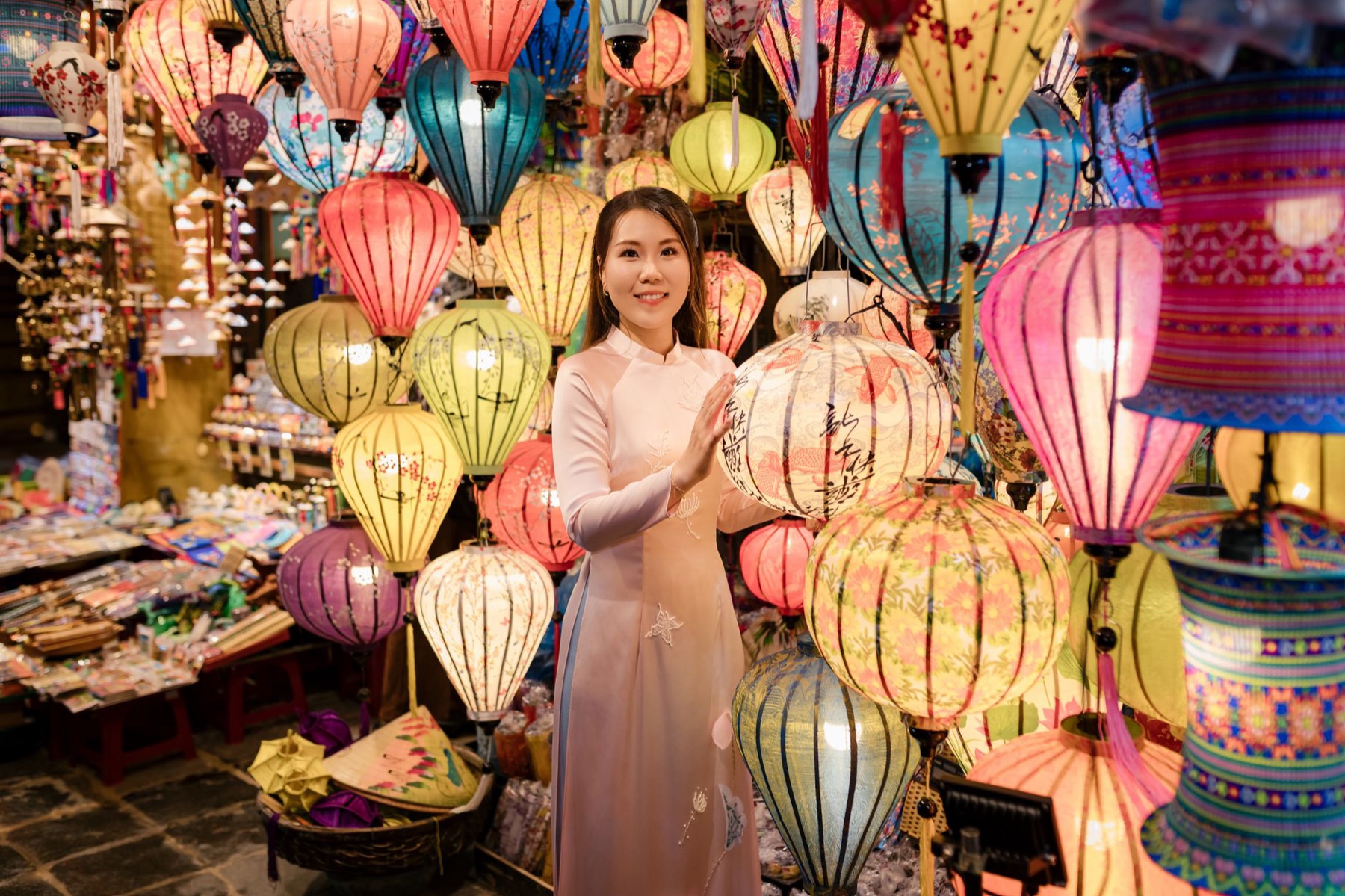
Chợ Đêm (Night Market, Nguyễn Hoàng) opens around 18:00 and closes by 23:00. It's where locals eat, not tourists—expect grilled meat, noodle soups, spring rolls, and bánh mì for 30,000–60,000 VND (≈US$1.20–2.50 per item). Arrive hungry; the atmosphere is chaotic, friendly, and genuinely Vietnamese. Avoid tables near the entrance (touristy markups); sit deeper in. No English menus, but point and nod works fine. Chợ vải Hội An (fabric market, central Old Town) sells silk, cotton, brocade, and ready-made áo dài at wholesale prices if you bargain. Entrance is free; a bolt of silk runs 150,000–500,000 VND (≈US$6–20) depending on quality. Many travelers skip the night market in favor of riverside restaurants—a mistake. The market is louder, messier, and far more authentic.
What should you skip—and why honest travel means saying no?
Lantern-release ceremonies on the Thu Bon River are tourist theater: vendors sell paper lanterns; tourists light them at sunset for photos. It's photogenic but environmentally destructive (thousands of lanterns litter the river and farmland), feels staged, and costs 100,000–200,000 VND (≈US$4–8) per lantern on top of a meal. Skip it entirely; watch the river from a café instead. "Cooking classes" marketed to tourists at inflated prices (500,000+ VND / ≈US$20+) often use tourists as unpaid labor; real home cooks rarely advertise. Motorbike rides to surrounding villages ("rural tours") are usually rushed, superficial, and uncomfortable. The souvenir-heavy central market near Chùa Cầu is a trap: prices are 2–3× higher than local markets, and quality is uniform and mediocre. Crowd-watching from a café—sitting on Nguyễn Hoàng or Phan Bội Châu, nursing coffee or beer for 20,000–40,000 VND (≈US$0.80–1.60)—reveals more about Hoi An than any tour.
🎟️ Compare tours & tickets for this place
What to check before you visit or buy
Timing matters: arrive in Hoi An on a weekday if possible; weekends bring crowds. Early morning (06:00–09:00) and late afternoon (16:00–18:00) are clearest.
Dress code: temples require covered shoulders and knees; wear lightweight long-sleeves or carry a sarong.
Bring cash: many small workshops, cafés, and the night market don't accept cards. ATMs are frequent but sometimes slow.
Buy from makers, not middlemen: if you want embroidery or lacquer, buy directly from the studio (prices fair, quality guaranteed) rather than at stall or hotel concierge markups.
Walking shoes: the Old Town is flat but uneven stone; wear comfortable, closed shoes. Sandals slip on wet evenings.
Water and sun protection: Hoi An is humid year-round; bring a hat, sunscreen, and refillable bottle (plastic bottles litter here—use a reusable one).
Language: English is spoken in tourist areas but weak in markets and workshops. Download Google Translate offline, or learn simple phrases.
Pricing reality check: if a "custom tailored áo dài" is quoted below 500,000 VND (≈US$20), it's a factory copy. Genuine custom work is 1–3 million VND (≈US$40–120) and takes 3–5 days.
---
For deeper planning, explore our Hoi An guide and Vietnam itinerary builder. If you're building a broader trip, see Hanoi, Ho Chi Minh City, Ha Long Bay, Ninh Binh, and Sapa guides. Traveling internationally? Check Vietnam e-visa and eSIM options before arrival.
FAQ
Is it worth hiring a guide in Hoi An?
Only if you want cultural depth (temples, history, dialect) or have mobility issues. Most attractions are walkable and labeled. Skip generic "Old Town tours"—they rush you. Hire a local guide for a half-day craft-studio visit or temple history instead.
What's the best time to visit—morning or evening?
Both. Morning (06:00–09:00) is quiet, cooler, and ideal for temples. Evening (17:00–19:00) is atmospheric but crowded. Visit major sites twice: once quiet, once lively, to choose your preference.
Do I need to buy an entry pass for the Old Town?
No official paid entry exists. You'll see "tourist passes" sold—ignore them. Each temple and museum charges separately (80,000–150,000 VND each). Total for 3–4 major museums ≈400,000–600,000 VND (≈US$16–24).
Are the craft workshops pressure-sales traps?
Legitimate studios (Sô.Va, Boa tang, Casa Tan my) have zero-pressure environments. You watch artisans; buying is optional. Avoid stalls near Chùa Cầu and coach-tour drop-off points—those are commission-driven.
Should I buy souvenirs—áo dài, silk, lacquer—here or wait for Hanoi or Ho Chi Minh City?
Hoi An is the best source for custom áo dài and high-quality embroidery and lacquer. Prices are competitive, and you can see the makers. Hanoi and Ho Chi Minh City have bigger selections but higher retail markup. If you want one item, buy it here.
FAQ
Is it worth hiring a guide in Hoi An?
Only if you want cultural depth (temples, history, dialect) or have mobility issues. Most attractions are walkable and labeled. Skip generic "Old Town tours"—they rush you. Hire a local guide for a half-day craft-studio visit or temple history instead.
What's the best time to visit—morning or evening?
Both. Morning (06:00–09:00) is quiet, cooler, and ideal for temples. Evening (17:00–19:00) is atmospheric but crowded. Visit major sites twice: once quiet, once lively, to choose your preference.
Do I need to buy an entry pass for the Old Town?
No official paid entry exists. You'll see "tourist passes" sold—ignore them. Each temple and museum charges separately (80,000–150,000 VND each). Total for 3–4 major museums ≈400,000–600,000 VND (≈US$16–24).
Are the craft workshops pressure-sales traps?
Legitimate studios (Sô.Va, Boa tang, Casa Tan my) have zero-pressure environments. You watch artisans; buying is optional. Avoid stalls near Chùa Cầu and coach-tour drop-off points—those are commission-driven.
Should I buy souvenirs—áo dài, silk, lacquer—here or wait for Hanoi or Ho Chi Minh City?
Hoi An is the best source for custom áo dài and high-quality embroidery and lacquer. Prices are competitive, and you can see the makers. Hanoi and Ho Chi Minh City have bigger selections but higher retail markup. If you want one item, buy it here.
More: Hoi An travel guide